
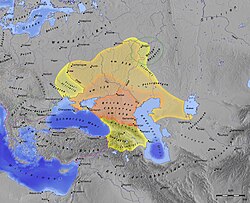
Xazar xoqonligi — Gʻarbiy turk xoqonligi parchalanishi natijasida VII asr oʻrtalarida Quyi Volgaboʻyi va Shimoliy Kavkazning sharkiy qismida vujudga kelgan ilk oʻrta asr davlati. Xazar xoqonligini turkiy Ashina xonadoni sulolasi boshqargan. VIII asr boshiga qadar xoqonlik poytaxti Dogʻistondagi Samandar shahri, soʻngra Quyi Volgadagi Itil sh. Boʻlgan. VII asrning 2-yarmida xazarlar Buyuk Bulgʻoriya davlati tarkibiga kiradigan Azovboʻyi bulgʻorlarining bir qismini tobe etganlar (qolgan qismi magʻlubiyatdan soʻng Oʻrta Volgaga, qolgani Dnepr ortiga, Dunay tomonga ketgan), shuningdek, Dogʻistonning dengiz boʻyidagi Gunnsavirlar podsholigini boʻysundirganlar. Kavkaz Albaniyasi Xazar xoqonligiga oʻlpon toʻlagan. Vizantiya Zakavkazyeda oʻrnashib olgan Arab xalifaligiga qarshi Xazar xoqonligi bilan ittifoq tuzgan. VIII asr boshiga kelib xazarlar Shimoliy Kavkaz, Azovboʻyi, Qrimning (Vizantiyadan tortib olingan) katta qismi, shuningdek, Sharqiy Yevropaning Dneprgacha choʻzilgan hududiga egalik qilganlar. Ayni vaqtda ular Zakavkazyeni qoʻlga kiritish uchun arablar bilan kurash olib borganlar. 795-yil Kaspiy yoʻlagi va Daryoli orqali arablar Xazar xoqonligi hududiga bostirib kirishgan va xoqon (qagʻan) qoʻshinini tormor keltirishgan. Xoqon va uning mulozimlari islom dinini qabul qilgan, biroq aholining aksariyati uni qabul qilmagani uchun ular ham dindan qaytganlar. VIII asrning 1-yarmida (taxminan 731-yil) Shimoliy Dogʻistondagi xazarlarning bir qismi iudaizm (yahudiylik)ni qabul qilgan (Shim. Dogʻistonga sosoniylar Eroni, keyinchalik Vizantiya tomonidan quvgʻin qilingan yahudiylar, jumladan, knyaz Bulan degan shaxs kelib joylashgandi). VIII asr oxiri — IX asr boshida Bulanning avlodlaridan biri — Obadiya Xazar xoqonligi taxtiga oʻtirgan va iudaizmni davlat dini deb eʼlon qilgan. Biroq bu boshqa xazar aslzodalarining noroziligiga sabab boʻlib, mamlakatda qoʻzgʻolon boshlangan. Qoʻzgʻolonchilar Volga ortidan madʼyarlarni, Obadiya esa koʻchmanchi gʻuzlarni yordamga chaqirgan. Qoʻzgʻolon bostirilgan, madʼyarlar Dnepr ortiga chekinganlar, ular bilan birga tirik qolgan isyonchilar (kabarlar) ham ketgan. Qrimdagi gotlar va boshqa xalqlar Xazar xoqonligidagi notinch vaziyatdan foydalanib Vizantiya homiyligiga oʻtishgan. Shu yillarda Don boʻyida Sarkel qalʼasi qurilgan, u Gʻarbdan Itilga keladigan savdo yoʻlini muhofaza etishga moʻljallangan. IX asr oxirida Shim. Qora dengiz boʻyiga bijanaklar (pecheneglar) bosib kirib Xazar xoqonligiga qaram boʻlgan madʼyarlarni Dunayboʻyiga haydab yuborishgan (895). Xazar xoqonligining asosiy raqibi Qad. Rus davlati boʻlgan. IX asrdan rus drujinalari Kaspiy dengiziga qadar kelib, xazarlar uchun oʻta muhim boʻlgan KaspiyVolga savdo yoʻliga fob boʻlishgan. 913/914 va 943/944 yillarda rus qoʻshinlari Xazariya hududidan oʻtib Kaspiy boʻyini gorat qilganlar. 964/965-yil rus knyazi Svyatoslav Igorevich Volgaga yurish qilib, Xazar xoqonligini tormor keltirgan. Itil va Samandar vayron etilgan. Sarkel sh. bosib olingan. X asrning 2-yarmida xazarlar islomni qabul qilish va tobe boʻlish evaziga Xorazm yordamida vaziyatni tiklamoqchi boʻlganlar. Biroq ichki nizolar, koʻchmanchi xalqlar (bijanaklar, gʻuzlar)ning bosqinlari, 964/965 yildagi magʻlubiyat va boshqa natijasida X asr oxiriga kelib Xazar xoqonligi barham topgan.
Yana qarang
- Idil
- Ashtarxon xonligi
Adabiyotlar
- Abu El-Haj, Nadia. The Genealogical Science: The Search for Jewish Origins and the Politics of Epistemology. Chicago, IL: University of Chicago Press, 2012. ISBN 978-0-226-20142-9.
- Abulafia, David „Asia, Africa and the Trade of Medieval Europe“, . The Cambridge Economic History of Europe: Trade and industry in the Middle Ages. Cambridge University Press, 1987 — 402–473-bet. ISBN 978-0-521-08709-4.
- Altschüler, Boris. Geheimbericht aus der Grossen Steppe. Die Wahrheit über das Reich der Russen (de). Saarbrücken: Altschüler, 1994. ISBN 978-3-9803917-0-2.
- Atzmon G, Hao L, Pe'er I, Velez C, Pearlman A, Palamara PF, Morrow B, Friedman E, Oddoux C, Burns E, Ostrer H (June 2010). „Abraham's children in the genome era: major Jewish diaspora populations comprise distinct genetic clusters with shared Middle Eastern Ancestry“. American Journal of Human Genetics. 86-jild, № 6. 850–859-bet. doi:10.1016/j.ajhg.2010.04.015. PMC 3032072. PMID 20560205.
- Bailey, H.W. (1949). (PDF). Asia Major. New Series 1.1. 28–52-bet. 2021-01-26da asl nusxadan (PDF) arxivlandi. Qaraldi: 2023-08-16.
- Bailey, H.W. (1951). (PDF). Asia Major. New Series 2.1. 1–45-bet. 2021-01-26da asl nusxadan (PDF) arxivlandi. Qaraldi: 2023-08-16.
- Barkun, Michael. Religion and the Racist Right: The Origins of the Christian Identity Movement. University of North Carolina Press, 1997 — 141-bet. ISBN 978-0-8078-4638-4.
- Barkun, Michael „Anti-Semitism from Outer Space: The Protocols in the UFO Subculture“, . The Paranoid Apocalypse: A Hundred-year Retrospective on the Protocols of the Elders of Zion. New York University Press, 2012 — 163–171-bet. ISBN 978-0-8147-4945-6.
- Baron, Salo Wittmayer. A Social and Religious History of the Jews. Columbia University Press, 1957.
- Barthold, Vasili (1993). "Khazar". in Houtsma, Martijn Theodoor; Bosworth, C.E.; van Donzel, E. et al.. First Encyclopedia of Islam, 1913–1936. 4. Brill. 935–937 b. ISBN 978-90-04-09790-2. https://books.google.com/books?id=7CP7fYghBFQC&pg=PA936.
- Bauer, Susan Wise. The History of the Medieval World: From the Conversion of Constantine to the First Crusade. New York, NY: W. W. Norton & Company, 2010. ISBN 978-0-393-07817-6.
- Beckwith, Christopher I.. Empires of the Silk Road: A History of Central Eurasia from the Bronze Age to the Present. Princeton, NJ: Princeton University Press, 2011. ISBN 978-0-691-15034-5.
- Behar, D. M.; Metspalu, M.; Baran, Y.; Kopelman, N. M.; Yunusbayev, B.; Gladstein, A.; et al. (2013). „No Evidence of a Khazar origin for the Ashkenazi Jews“. Human Biology. 85-jild, № 6. 859–900-bet. doi:10.3378/027.085.0604. PMID 25079123. S2CID 2173604.
- Behar, Doron M; Thomas, Mark G; Skorecki, Karl; Hammer, Michael F; et al. (October 2003). „Multiple Origins of Ashkenazi Levites: Y Chromosome Evidence for Both Near Eastern and European Ancestries“. American Journal of Human Genetics. 73-jild, № 4. 768–779-bet. doi:10.1086/378506. PMC 1180600. PMID 13680527.
- Blady, Ken. Jewish Communities in Exotic Places. Rowman & Littlefield, 2000. ISBN 978-0-765-76112-5.
- Boller, Paul F.. Memoirs of an Obscure Professor: And Other Essays. TCU Press, 1992. ISBN 978-0-87565-097-5.
- Bowersock, G.W.. The Throne of Adulis: Red Sea Wars on the Eve of Islam. Oxford University Press, 2013. ISBN 978-0-199-33384-4.
- Bowman, Stephen B.; Ankori, Zvi. The Jews of Byzantium 1204–1453. Bloch Publishing Company, 2001. ISBN 978-0-8197-0703-1.
- Brook, Kevin Alan. The Jews of Khazaria. Lanham, Maryland: Rowman & Littlefield, 2006 — 192-bet. ISBN 978-144220302-0.
- Brook, Kevin Alan. The Jews of Khazaria, 2nd, Rowman & Littlefield, 2010. ISBN 978-0-7425-4982-1.
- Brook, Kevin Alan (Summer 2014). (PDF). Karadeniz Arastirmalari. 11-jild, № 42. 69–84-bet. doi:10.12787/KARAM859. 2 June 2019da asl nusxadan (PDF) arxivlandi. Qaraldi: 2023-08-16.
{{cite magazine}}: More than one of|archivedate=va|archive-date=specified (yordam); More than one of|archiveurl=va|archive-url=specified (yordam) - Brook, Kevin Alan. The Jews of Khazaria, 3rd, Rowman & Littlefield, 2018. ISBN 978-1-5381-0342-5.
- Brook, Kevin Alan. The Maternal Genetic Lineages of Ashkenazic Jews. Academic Studies Press, 2022. ISBN 978-1-64469-984-3.
- Browning, Robert. The Byzantine Empire, 2nd, Catholic University of America Press, 1992 — 53-bet. ISBN 978-0-8132-0754-4.
- Burrage Dixon, Roland. The Racial History of Man. C. Scribners sons, 1923.
- Cahen, Claude. L'Islam, des origines au début de l'Empire ottoman, 2nd (fr), Hachette, 2011. ISBN 978-2-8185-0155-9.
- Cameron, Averil (1996). „Byzantines and Jews: some recent work on early Byzantium“. Byzantine and Modern Greek Studies. 20-jild. 249–274-bet. doi:10.1179/byz.1996.20.1.249. S2CID 162277927.
- Cameron, Averil; Herrin, Judith. Constantinople in the Early Eighth Century: The Parastaseis Syntomoi Chronikai: Introduction, Translation, and Commentary, Columbia Studies in the Classical Tradition. Brill Archive, 1984. ISBN 978-90-04-07010-3.
- Cohen, Mark R.. The Voice of the Poor in the Middle Ages: An Anthology of Documents from the Cairo Geniza, Jews, Christians, and Muslims from the Ancient to the Modern World Series. Princeton University Press, 2005. ISBN 978-0-691-09271-3.
- Cokal, Susann. „Jews With Swords“ (2007-yil 28-oktyabr). Qaraldi: 2013-yil 5-avgust.
- Costa, M. D.; Pereira, Joana B.; Richards, Martin B. (8 October 2013). „A substantial prehistoric European ancestry amongst Ashkenazi maternal lineages“. Nature Communications. 4-jild. 2543-bet. Bibcode:2013NatCo...4.2543C. doi:10.1038/ncomms3543. PMC 3806353. PMID 24104924.
- The Russian Primary Chronicle (Laurentian text). Cambridge, MA: The Mediaeval Academy of America, 1953.
- Davies, Alan „The Keegstra Affair“, . Antisemitism in Canada: History and Interpretation. Wilfrid Laurier University Press, 1992 — 227–248-bet. ISBN 978-0-889-20216-0.
- DeWeese, Devin A.. Islamization and Native Religion in the Golden Horde: Baba Tükles and Conversion to Islam in Historical and Epic Tradition, Hermeneutics, Studies in the History of Religions. Penn State Press, 1994. ISBN 978-0-271-04445-3.
- Dinur, Ben-Zion. Yisrael ba-gola, 3rd, Bialik Institute, 1961.
- Dobrovits, M. (2004). „The Thirty Tribes of the Turks“. Acta Orientalia Academiae Scientiarum Hungaricae. 57-jild, № 3. 259-bet. doi:10.1556/aorient.57.2004.3.1.
- Dubnov, Simon. History of the Jews: From the Roman Empire to the Early Medieval Period. Associated University Presses, 1980. ISBN 978-0-8453-6659-2.
- Dunlop, Douglas Morton. History of the Jewish Khazars. New York, NY: Schocken Books, 1954.
- „Early History“, A Country Study: Hungary, Library of Congress Country Studies. Federal Research Division, Library of Congress, September 1989.
- Elhaik, Eran (December 2012). „The Missing Link of Jewish European Ancestry: Contrasting the Rhineland and the Khazarian Hypotheses“. Genome Biology and Human Evolution. 5-jild, № 1. 61–74-bet. arXiv:1208.1092. Bibcode:2012arXiv1208.1092E. doi:10.1093/gbe/evs119. PMC 3595026. PMID 23241444.
- Erdal, Marcel „The Khazar Language“, . The World of the Khazars: New Perspectives, Handbuch der Orientalistik: Handbook of Uralic studies. BRILL, 2007 — 75–108-bet. ISBN 978-90-04-16042-2.
- Falk, Raphael. Zionism and the Biology of Jews. Springer, 2017. ISBN 978-3-319-57345-8.
- Feldman, Alex M. (2022). „The Decline and Fall of Khazaria – Might or Money?“. Vostok (Oriens). № 4. 75–84-bet. doi:10.31857/S086919080021412-0. S2CID 253192191.
- Feldman, Louis H.. Jew and Gentile in the Ancient World: Attitudes and Interactions from Alexander to Justinian. Princeton University Press, 1996. ISBN 978-1-4008-2080-1.
- Fishberg, Maurice. The Jews: A Study of Race and Environment. Scribner's, 1911.
- Geanakoplos, Deno John. Byzantium: Church, Society, and Civilization Seen through Contemporary Eyes, 2nd, University of Chicago Press, 1984. ISBN 978-0-226-28461-3.
- Gil, Moshe (July–December 2011). „Did the Khazars Convert to Judaism?“. Revue des Études Juives. 170-jild, № 3–4. 429–441-bet. doi:10.2143/REJ.170.3.2141801.
- Golb, Norman; Pritsak, Omeljan. Khazarian Hebrew Documents of the Tenth Century. Cornell University Press, 1982. ISBN 978-080141221-9.
- Golden, Peter B. (July 2018). „The Ethnogonic Tales of the Türks“. The Medieval History Journal. 21-jild, № 2. 294-bet. doi:10.1177/0971945818775373. S2CID 166026934.
- Golden, Peter Benjamin. Khazar Studies: An Historio-Philological Inquiry into the Origins of the Khazars. Budapest: Akademia Kiado, 1980. ISBN 978-0-226-28461-3.
- Golden, Peter Benjamin. An Introduction to the History of the Turkic Peoples: Ethnogenesis And State Formation in the Medieval and Early Modern Eurasia and the Middle East, Turcologica. Wiesbaden: O. Harrassowitz, 1992. ISBN 978-3-447-03274-2.
- Golden, Peter Benjamin „The peoples of the South Russian steppes“, . The Cambridge History of Early Inner Asia. Cambridge University Press, 1994a — 256–283-bet. ISBN 978-0-521-24304-9.
- Golden, Peter Benjamin „The peoples of the Russian forest belt“, . The Cambridge History of Early Inner Asia. Cambridge University Press, 1994b — 230–255-bet. ISBN 978-0-521-24304-9.
- Golden, Peter Benjamin „Nomads in the Sedentary World: The Case of Pre-Chinggisid Rus' and Georgia“, . Nomads in the Sedentary World, Curzon-IIAS Asian studies series. Routledge, 2001a — 24–74-bet. ISBN 978-0-7007-1369-1.
- Golden, Peter Benjamin „Nomad and Sedentary societies in Eurasia“, . Agricultural and Pastoral Societies in Ancient and Classical History, Critical Perspectives on the Past Series. American Historical Association. Temple University Press, 2001b — 71–115-bet. ISBN 978-1-56639-832-9.
- Golden, Peter Benjamin. Nomads and their neighbours in the Russian steppe: Turks, Khazars and Qipchaqs. Ashgate, 2003. ISBN 978-0-86078-885-0.
- Golden, Peter Benjamin „The Khazar Sacral Kingship“, . Pre-modern Russia and its world: Essays in Honour of Thomas S. Noonan. Otto Harrassowitz Verlag, 2006 — 79–102-bet. ISBN 978-3-447-05425-6.
- Golden, Peter Benjamin (2007a). "Khazar Studies: Achievements and Perspectives". in Golden, Peter B.; Ben-Shammai, Haggai; Róna-Tas, András. The World of the Khazars: New Perspectives. Handbook of Oriental Studies. 17. Brill. 7–57 b. ISBN 978-90-04-16042-2. https://books.google.com/books?id=3ZzXjdyK-CEC&pg=PR2.
- Golden, Peter Benjamin (2007b). "The Conversion of the Khazars to Judaism". in Golden, Peter B.; Ben-Shammai, Haggai; Róna-Tas, András. The World of the Khazars: New Perspectives. Handbook of Oriental Studies. 17. Brill. 123–161 b. ISBN 978-90-04-16042-2. https://books.google.com/books?id=3ZzXjdyK-CEC&pg=PR2.
- Golden, Peter Benjamin (2007c). „Irano-Turcica: The Khazar Sacral Kingship Revisited“. Acta Orientalia Academiae Scientiarum Hungaricae. 60-jild, № 2. 161–194-bet. doi:10.1556/AOrient.60.2007.2.2 — ResearchGate.
- Golden, Peter Benjamin. Turks and Khazars: Origins, Institutions, and Interactions in Pre-Mongol Eurasia, Variorum Collected Studies Series. Ashgate Publishing, 2010. ISBN 978-1-4094-0003-5.
- Golden, Peter Benjamin. Central Asia in World History, New Oxford World History. Oxford University Press, 2011a. ISBN 978-0-19-979317-4.
- Golden, Peter Benjamin. Studies on the Peoples and Cultures of the Eurasian Steppes. Editura Academiei Române, 2011b. ISBN 978-973-27-2152-0.
- Goldstein, Eric L.. The Price of Whiteness: Jews, Race, and American Identity. Princeton University Press, 2006. ISBN 978-069112105-5.
- Goldstein, Miriam. Karaite Exegesis in Medieval Jerusalem. Mohr Siebeck, 2011 — 9-bet. ISBN 978-316150972-8.
- Goodman, David G.; Miyazawa, Masanori. Jews in the Japanese Mind: The History and Uses of a Cultural Stereotype. Lexington Books, 2000. ISBN 978-0-7391-0167-4.
- Goodrick-Clarke, Nicholas. Black Sun: Aryan cults, esoteric nazism, and the politics of identity. NYU Press, 2003. ISBN 978-0-8147-3155-0.
- Gow, Andrew Colin. The " Red Jews": Antisemitism in the Apocalyptic Age 1200–1600. Brill Publishers, 1995. ISBN 978-90-04-10255-2.
- HaLevi, Yehuda. The Kuzari: In Defense of the Despised Faith. Northvale, New Jersey-Jerusalem: Jason Aronson, 1998. ISBN 978-0-7657-9970-8.
- HaLevi, Yehudah. The Kuzari. In Defense of the Despised Faith, 2nd, Feldheim Publishers, 2013. ISBN 978-159826961-1.
- Harkabi, Yehoshafat „Contemporary Arab Anti-Semitism: its Causes and Roots“, . The Persisting Question: Sociological Perspectives and Social Contexts of Modern Antisemitism. Walter de Gruyter, 1987 — 412–427-bet. ISBN 978-3-11-010170-6.
- Heath, Ian. Byzantine Armies 886-1118. Osprey Publishing, 1979. ISBN 978-0-85045306-5.
- Herlihy, David (1984). "Demography". in Strayer, Joseph R.. Dictionary of the Middle Ages. 4. Charles Scribner's Sons. 136–148 b. ISBN 978-0-684-17024-4.
- Howorth, H. H. (1870). „On the Westerly Drifting of Nomades, from the Fifth to the Nineteenth Century. Part IV. The Circassians and White Khazars“. The Journal of the Ethnological Society of London. 2-jild, № 2. 182–192-bet. doi:10.2307/3014425. JSTOR 3014425.
- Inaba, Minoru; Balogh, Dániel „The legend of Xinnie in the seventh and eighth centuries“, . Hunnic Peoples in Central and South Asia: Sources for their Origin and History. Barkhuis, 2020 — 103–107-bet. ISBN 978-9-493-19401-4.
- Kaegi, Walter Emil. Heraclius, Emperor of Byzantium, 2nd, Cambridge University Press, 2003. ISBN 978-0-521-81459-1.
- "Khazar". Encyclopedia Britannica. 29 March 2020. https://www.britannica.com/topic/Khazar.
- Kim, Hyun Jin. The Huns. Routledge, 2016. ISBN 978-1-317-34090-4.
- Kizilov, Mikhail. The Karaites of Galicia: An Ethnoreligious Minority Among the Ashkenazim, the Turks, and the Slavs, 1772–1945. Brill, 2009. ISBN 978-90-04-16602-8.
- Kizilov, Mikhail „National Inventions: The Imperial Emancipation of the Karaites from Jewishness“, . An Empire of Others: Creating Ethnographic Knowledge in Imperial Russia and the USSR. Central European University Press, 2014 — 369–393-bet. ISBN 978-6-155-22576-5.
- Koestler, Arthur. The Thirteenth Tribe: The Khazar Empire and Its Heritage. London: Pan Books, 1977. ISBN 978-0-09-125550-3. [sayt ishlamaydi]
- Kohen, Elli. History of the Byzantine Jews: A Microcosmos in the Thousand Year Empire. University Press of America, 2007. ISBN 978-0-7618-3623-0.
- Kolditz, Sebastian „Barbarian Emperors? Aspects of the Byzantine Perception of the qaghan (chaganos) in the Earlier Middle Ages“, . Transcultural Approaches to the Concept of Imperial Rule in the Middle Ages. Peter Lang, 2017 — 41–76-bet. ISBN 978-3-631-70624-4.
- Kordosis, Stefanos (2017). „The Tibetan Title Dru gu Gesar (Turk Caesar / Caesar of the Turks) in the Northern Branch of the Silk Route and the Role of the Khazars“. ΘΗΣΑΥΡΙΣΜΑΤΑ. № 47. 183–192-bet.
- Kornienko, I. V.; Faleeva, T. G.; Schurr, T. G.; Aramova, O. Yu; Ochir-Goryaeva, M. A.; Batieva, E. F.; Vdovchenkov, E. V.; Moshkov, N. E.; Kukanova, V. V.; Ivanov, I. N.; Sidorenko, Yu S. (1 April 2021). „Y-Chromosome Haplogroup Diversity in Khazar Burials from Southern Russia“. Russian Journal of Genetics. 57-jild, № 4. 477–488-bet. doi:10.1134/S1022795421040049. ISSN 1608-3369. S2CID 233479468 — ResearchGate.
- Kovalev, R.K. „Creating Khazar Identity through Coins: the Special Issue Dirhams of 837/838“, . East Central and Eastern Europe in the Early Middle Ages, Ann Arbor, 2005 — 220–251-bet. ISBN 978-047211498-6.
- von Kutschera, Hugo. Die Chasaren; historische Studie (de). A. Holzhauen, 1909. ISBN 978-027447307-6.
- Lee, Joo-Yup (2016). . Central Asiatic Journal. 59-jild, № 1–2. 101–132-bet. doi:10.13173/centasiaj.59.1-2.0101. 2021-12-23da asl nusxadan arxivlandi. Qaraldi: 2023-08-16.
- Leviant, Curt. Masterpieces of Hebrew Literature: Selections from 2000 Years of Jewish Creativity. Jewish Publication Society, 2008. ISBN 978-0-8276-0954-9.
- Lewis, Bernard. Semites and Anti-Semites: An Inquiry Into Conflict and Prejudice. New York: W. W. Norton & Company, 1987. ISBN 978-0-393-30420-6.
- Lewis, Bernard. The Jews of Islam. Routledge, 2013. ISBN 978-1-135-03021-6.
- Litman, Jacob. The Economic Role of Jews in Medieval Poland: The Contribution of Yitzhak Schipper. University Press of America, 1984. ISBN 978-081914244-3.
- Lobel, Diana. Between Mysticism and Philosophy: Sufi Language of Religious Experience in Experience in Judah Ha-Levi's Kuzari. SUNY Press, 2000. ISBN 978-079144451-1.
- Logan, F. Donald. The Vikings in History, 2nd, Routledge, 1992. ISBN 978-0-415-08396-6.
- Luttwak, Edward N.. The Grand Strategy of the Byzantine Empire. Harvard University Press, 2009. ISBN 978-0-674-03519-5.
- „Magyars“. WebChron: The Web Chronology Project. Qaraldi: 2013-yil 22-avgust.
- Makkai, László „The Hungarians' Prehistory, Their Conquest of Hungary and their raids to the West“, . A History of Hungary. Indiana University Press, 1994 — 11-bet. ISBN 0-253-35578-8.
- Mako, Gerald (2010). „The Possible Reasons for the Arab-Khazar Wars“. Archivum Eurasiae Medii Aevi. 17-jild. 45–57-bet.
- Malkiel, David. Reconstructing Ashkenaz: The Human Face of Franco-German Jewry, 1000–1250. Stanford University Press, 2008. ISBN 978-0-8047-8684-3.
- The Oxford History of Byzantium. Oxford University Press, 2002. ISBN 978-0-19-814098-6.
- Mariner, Rodney „Conversion to Judaism: a tale of the good, the bad and the ungrateful“, . Religious Conversion: Contemporary Practices and Controversies. A&C Black, 1999 — 89–101-bet. ISBN 978-0-826-43713-6.
- Maroney, Eric. The Other Zions: The Lost Histories of Jewish Nations. Rowman & Littlefield, 2010 — 55-bet. ISBN 978-1-4422-0045-6.
- Melamed, Avraham. The Philosopher-King in Medieval and Renaissance Jewish Political Thought. SUNY Press, 2003. ISBN 978-0-7914-8770-9.
- Meserve, Margaret. Empires of Islam in Renaissance Historical Thought, Harvard Historical Series. Harvard University Press, 2009. ISBN 978-0-674-02656-8.
- Andoza:Cite bioRxiv
- Miller, Philip E.. Karaite Separatism in Nineteenth-Century Russia: Joseph Solomon Lutski's Epistle of Israel's Deliverance. Cincinnati: Hebrew Union College Press, 1993. ISBN 978-0-878-20137-2.
- Morris, Benny. The Road to Jerusalem: Glubb Pasha, Palestine and the Jews. I. B. Tauris, 2003. ISBN 978-1-86064-989-9.
- Moss, Walter. A History of Russia: To 1917, Anthem Russian and Slavonic studies. Anthem Press, 2002. ISBN 978-0-85728-752-6.
- Nebel, Almut; Filon, Dvora; Brinkmann, B (2001). „The Y chromosome pool of Jews as part of the genetic landscape of the Middle East“. American Journal of Human Genetics. 69-jild, № 5. 1095–1112-bet. doi:10.1086/324070. PMC 1274378. PMID 11573163.
- Nebel, Almut; Filon, Dvora; Faerman, Marina (March 2005). „Y chromosome evidence for a founder effect in Ashkenazi Jews“. European Journal of Human Genetics. 13-jild, № 3. 388–391-bet. doi:10.1038/sj.ejhg.5201319. PMID 15523495. S2CID 1466556.
- Noonan, Thomas S. „European Russia c500-c1050“, . The New Cambridge Medieval History: Volume 3, C.900-c.1024. Cambridge University Press, 1999 — 485–534-bet. ISBN 978-0-521-36447-8.
- Noonan, Thomas S. „The Khazar Qaghanate and its impact on the early Rus' state: the Translatio Imperii from Itil to Kiev“, . Nomads in the Sedentary World, Curzon-IIAS Asian studies series. Routledge, 2001 — 76–102-bet. ISBN 978-0-7007-1369-1.
- Noonan, Thomas S. „The Economy of the Khazar Khaganate“, . The World of the Khazars: New Perspectives, Handbuch der Orientalistik: Handbook of Uralic studies. Brill, 2007 — 207–244-bet. ISBN 978-90-04-16042-2.
- Olsson, Joshua T. (2013). „Coup d'état, Coronation and Conversion: Some Reflections on the Adoption of Judaism by the Khazar Khaganate“. Journal of the Royal Asiatic Society. 23-jild, № 4. 495–526-bet. doi:10.1017/S1356186313000266. S2CID 161833156.
- Oppenheim, Samuel A (1994). "Jews". in Olson, James Stuart; Pappas, Lee Brigance; Pappas, Charles. Jews. Greenwood Publishing Group. 305–328 b. ISBN 978-0-313-27497-8. https://books.google.com/books?id=CquTz6ps5YgC&pg=PA310.
- Ostrer, Harry. Legacy: A Genetic History of the Jewish People. Oxford University Press, 2012. ISBN 978-0-19-997638-6.
- Ostrogorski, George. History of the Byzantine State. Rutgers University Press, 1969. ISBN 978-0-8135-0599-2.
- Patai, Raphael; Patai, Jennifer. The Myth of the Jewish Race. Wayne State University Press, 1989. ISBN 978-0-8143-1948-2.
- Peacock, Andrew C.S.. Early Seljūq History: A New Interpretation. Routledge, 2010. ISBN 978-0-415-54853-3.
- Petrukhin, Vladimir „Khazaria and Rus': An Examination of their Historical Relations“, . The World of the Khazars: New Perspectives, Handbuch der Orientalistik: Handbook of Uralic studies. BRILL, 2007 — 245–268-bet. ISBN 978-90-04-16042-2.
- Petrukhin, Vladimir; Flyorov, Valeriy „Iudaizm v Khazarii po dannym arkheologii“, . Istoriya yevreyskogo naroda v Rossii. Ot drevnosti do rannego Novogo vremeni (ru). Moscow; Jerusalem: Bridges of Culture; Gerashim, 2010 — 149–161-bet. ISBN 978-545751756-1.
- Piltz, Elisabeth „Middle Byzantine Court Costume“, . Byzantine Court Culture from 829 To 1204. Dumbarton Oaks, 2004 — 39–52-bet. ISBN 978-0-88402-308-1.
- Poliakov, Léon. The History of Anti-semitism: From the time of Christ to the court Jews. University of Pennsylvania Press, 2005. ISBN 978-0-8122-1863-3.
- The Jews in Old Poland: 1000–1795. I. B. Tauris, 1993. ISBN 978-1-85043-342-2.
- Pritsak, Omeljan (September 1978). „The Khazar Kingdom's Conversion to Judaism“ (PDF). Harvard Ukrainian Studies. II-jild, № 3. 261–281-bet.
- Rezakhani, Khodadad. ReOrienting the Sasanians: East Iran in Late Antiquity. Edinburgh University Press, 2017. ISBN 978-1-474-40031-2.
- Róna-Tas, András. Hungarians & Europe in the Early Middle Ages: An Introduction to Early Hungarian History. Central European University Press, 1999. ISBN 978-963-9116-48-1.
- Rossman, Vadim Joseph. Russian Intellectual Antisemitism in the Post-Communist Era. University of Nebraska Press, 2002. ISBN 978-0-8032-3948-7.
- Rossman, Vadim Joseph „Anti-Semitism in Eurasian Historiography: The Caser of Lev Gumilev“, . Russia Between East and West: Scholarly Debates on Eurasianism, International Studies in Sociology and Social Anthropology. BRILL, 2007 — 121–188-bet. ISBN 978-90-04-15415-5.
- Rubin, Rita. „'Jews a Race' Genetic Theory Comes Under Fierce Attack by DNA Expert“ (2013-yil 7-may). Qaraldi: 2014-yil 9-iyun.
- Russell, Josiah C. „The Population in Europe“, . The Fontana Economic History of Europe: The Middle Ages. Collins/Fontana, 1972 — 25–71-bet.
- Sand, Shlomo. The Invention of the Jewish People. London: Verso Books, 2010. ISBN 978-1-84467-623-1.
- Schama, Simon. The Story of the Jews: Finding the Words (1000 BCE – 1492). Random House, 2013. ISBN 978-1-409-04004-0.
- Schwartzwald, Jack L.. The Collapse and Recovery of Europe, AD 476-1648. McFarland, 2015. ISBN 978-1-476-66230-5.
- Schweid, Eliezer „The Khazar motif in Judah Halevi's Sefer ha-Kuzari“, . The World of the Khazars: New Perspectives, Handbuch der Orientalistik: Handbook of Uralic studies. Brill, 2007 — 279–290-bet. ISBN 978-90-04-16042-2.
- Serrano, Miguel. Adolf Hitler, the Ultimate Avatar, 2011 — 79, 295-bet.
- Shapira, Dan D. Y. (2009). "Jews in Khazaria". in Ehrlich, Mark Avrum. Encyclopedia of the Jewish Diaspora: Origins, Experiences, and Culture. 3: (Countries, Regions, and Communities). ABC-CLIO. 1097–1104 b. ISBN 978-1-85109-873-6. https://books.google.com/books?id=NoPZu79hqaEC&pg=PA1097.
- Shapira, Dan D.Y. (2006). „Remarks on Avraham Firkovicz and the Hebrew Mejelis "Document"“. Acta Orientalia Academiae Scientiarum Hungaricae. 59-jild, № 2. 131–180-bet. doi:10.1556/AOrient.59.2006.2.1.
- Shapira, Dan D.Y. (2007a). "Iranian Sources on the Khazars". in Golden, Peter B.; Ben-Shammai, Haggai; Róna-Tas, András. The World of the Khazars: New Perspectives. 17. Brill. 291–305 b. ISBN 978-90-04-16042-2. https://books.google.com/books?id=3ZzXjdyK-CEC&pg=PR2.
- Shapira, Dan D.Y. (2007b). "Armenian and Georgian Sources on the Khazars – A Re-Evaluation". in Golden, Peter B.; Ben-Shammai, Haggai; Róna-Tas, András. The World of the Khazars: New Perspectives. Handbook of Oriental Studies. 17. Brill. 307–351 b. ISBN 978-90-04-16042-2. https://books.google.com/books?id=3ZzXjdyK-CEC&pg=PR2.
- Shepard, Jonathan „Closer Encounters with the Byzantine World: The Rus at the Straits of Kerch“, . Pre-modern Russia and its world: Essays in Honour of Thomas S. Noonan. Otto Harrassowitz Verlag, 2006 — 15–77-bet. ISBN 978-3-447-05425-6.
- Shingiray, Irina Lita „Ethos, Materiality and Paradigms of Political Action in Early Medieval Communities of the Northwestern Caspian Region“, . The Archaeology of Power and Politics in Eurasia: Regimes and Revolutions. Cambridge University Press, 2012 — 188–216-bet. ISBN 978-1-107-01652-1.
- Shirota, Shun (城田俊) (2005). Woods, John E.; Pfeiffer, Judith; Tucker, Ernest (muh.). „The Chinese Chroniclers of the Khazars: Notes on Khazaria in Tang Period Texts“. Archivum Eurasiae Medii Aevi. 14-jild. 231–261-bet.
- Shnirelman, Victor A „The Story of an Euphemism: The Khazars in Russian Nationalist Literature“, . The World of the Khazars: New Perspectives, Handbuch der Orientalistik: Handbook of Uralic studies. Brill, 2007 — 353–372-bet. ISBN 978-90-04-16042-2.
- Singerman, Robert „Contemporary Racist and Judeophobic Ideology Discovers the Khazars, or, Who Really Are the Jews?“ (2004). 2014-yil 5-martda asl nusxadan . Qaraldi: 2014-yil 1-mart.
- Sneath, David. The Headless State: Aristocratic Orders, Kinship Society, and Misrepresentations of Nomadic Inner Asia. Columbia University Press, 2007. ISBN 978-0-231-51167-4.
- Somogyi, Péter „New remarks on the flow of Byzantine coins in Avaria and Walachia during the second half of the seventh century“, . The "Other" Europe in the Middle Ages: Avars, Bulgars, Khazars and Cumans, East Central and Eastern Europe in the Middle Ages, 450–1450. Brill, 2008 — 83–149-bet. ISBN 978-90-04-16389-8.
- Spinei, Victor. The Romanians and the Turkic Nomads North of the Danube Delta from the Tenth to the Mid-Thirteenth Century. BRILL, 2009. ISBN 978-9-004-17536-5.
- Spolsky, Bernard. The Languages of the Jews: A Sociolinguistic History. Cambridge University Press, 2014. ISBN 978-1-107-05544-5.
- Stampfer, Shaul (2013). „Did the Khazars Convert to Judaism?“ (PDF). Jewish Social Studies. 19-jild, № 3. 1–72-bet. doi:10.2979/jewisocistud.19.3.1. S2CID 161320785 — Project MUSE.
- Stampfer, Shaul (2014). „Are We All Khazars Now?“. Jewish Review of Books. 1–72-bet.
- Szádeczky-Kardoss, Samuel (1994). "The Avars". in Sinor, Denis. The Cambridge History of Early Inner Asia. Handbook of Oriental Studies. 1. Cambridge University Press. 206–228 b. ISBN 978-0-521-24304-9. https://books.google.com/books?id=ST6TRNuWmHsC&pg=PR5.
- Szpiech, Ryan. Conversion and Narrative: Reading and Religious Authority in Medieval Polemic. University of Pennsylvania Press, 2012. ISBN 978-0-8122-0761-3.
- Szyszman, Simon. Le karaïsme: ses doctrines et son histoire (fr). Éditions L'Âge d'Homme, 1980. ISBN 978-282513088-9.
- Taagepera, Rein (September 1997). „Expansion and Contraction Patterns of Large Polities: Context for Russia“. International Studies Quarterly. 41-jild, № 3. 496-bet. doi:10.1111/0020-8833.00053. JSTOR 2600793.
- Toch, Michael. The Economic History of European Jews: Late Antiquity and Early Middle Ages, Études sur le Judaïsme Médiéval. Leiden: Brill Publishers, 2012. ISBN 978-90-04-23534-2.
- Toynbee, Arnold. A Study of History. Oxford University Press, 1962.
- Turchin, Peter; Adams, Jonathan M.; Hall, Thomas D (December 2006). „East-West Orientation of Historical Empires“. Journal of World-Systems Research. 12-jild, № 2. 222-bet. ISSN 1076-156X.
- Vogt, Judith (1975). „Left‐wing 'anti‐Zionism' in Norway“. Patterns of Prejudice. 9-jild, № 6. 15–q8-bet. doi:10.1080/0031322X.1975.9969275.
- Wachtel, Andrew. Making a Nation, Breaking a Nation: Literature and Cultural Politics in Yugoslavia. Stanford University Press, 1998 — 210–215-bet. ISBN 978-0-8047-3181-2.
- Wang, Pu. Tang Huiyao (zh).
- Wang, Pu. Tang Huiyao (zh).
- Wasserstein, David „The Khazars and the World of Islam“, . The World of the Khazars: New Perspectives, Handbuch der Orientalistik: Handbook of Uralic studies. Brill, 2007 — 373–386-bet. ISBN 978-90-04-16042-2.
- Wei, Zheng „vol. 84“, . Book of Sui (zh).
- Weinryb, Bernard Dov. The Jews of Poland: A Social and Economic History of the Jewish Community in Poland from 1100 to 1800. Jewish Publication Society, 1973a — 21–22-bet. ISBN 978-082760016-4.
- Weinryb, Bernard Dov. The Jews of Poland: A Social and Economic History of the Jewish Community in Poland from 1100 to 1800 he non-Jewish origins of the Sephardic Jews. Jewish Publication Society, 1973b. ISBN 978-0-8276-0016-4.
- Wells, H. G.. The Outline of History: Being a Plain History of Life and Mankind. Macmillan, 1920.
- Wexler, Paul. Explorations in Judeo-Slavic Linguistics, Contributions to the sociology of Jewish languages. Brill Archive, 1987. ISBN 978-90-04-07656-3.
- Wexler, Paul. The non-Jewish origins of the Sephardic Jews. SUNY, 1996. ISBN 978-1-4384-2393-7.
- Wexler, Paul. Two-Tiered Relexification in Yiddish: Jews, Sorbs, Khazars and the Kiev-Polessian Dialect, Trends in linguistics / Studies and monographs: Studies and monographs. Walter de Gruyter, 2002. ISBN 978-3-11-017258-4.
- Wexler, Paul „Yiddish Evidence for the Khazar Component in the Ashkenazic ethnogenesis“, . The World of the Khazars: New Perspectives, Handbuch der Orientalistik: Handbook of Uralic studies. Brill, 2007 — 387–398-bet. ISBN 978-90-04-16042-2.
- Whittow, David. The Making of Byzantium, 600–1025. University of California Press, 1996. ISBN 978-0-520-20496-6.
- Xin, Tangshu. New Book of Tang (zh).
- Zhivkov, Boris. Khazaria in the Ninth and Tenth Centuries. BRILL, 2015. ISBN 978-9-004-29448-6.
- Zimonyi, István. The Origins of the Volga Bulghars, Studia Uralo-Altaica, 32, 1990. ISBN 978-963481839-7.
- Zuckerman, Constantine (1995). „On the date of the Khazars' Conversion to Judaism and the Chronology of the Kings of the Rus' Oleg and Igor“. Revue des études byzantines. 53-jild. 237–270-bet. doi:10.3406/rebyz.1995.1906.
- Zuckerman, Constantine „The Khazars and Byzantium –The First Encounter“, . The World of the Khazars: New Perspectives, Handbuch der Orientalistik: Handbook of Uralic studies. Brill, 2007 — 399–431-bet. ISBN 978-90-04-16042-2.
- .
- Tarix
- Turkiy davlatlar
- Xazarlar
- Yahudiylarning siyosati
- Xonliklar
- Yevropadagi turkiy xalqlar